How to Stop Doomscrolling (Without Quitting Everything)
Willpower isn't the problem. Here's how to stop doomscrolling by changing what your phone shows you, with the research on why it's so hard to stop.
You know the feeling. You picked up your phone for a reason you can no longer remember, and you've been scrolling for long enough that the room has gotten dark. You weren't enjoying it. You'd struggle to name a single thing you saw.
Almost every article about this tells you to be more disciplined. I think that's the least useful advice available, because it misdiagnoses the problem. You're not scrolling because you lack willpower. You're scrolling because a very large number of very smart people are paid to make sure you do.
Why it's so hard to stop
Some numbers worth sitting with. A 2026 study by Virgin Media O2 followed more than 6,000 people for a year and found that 36% of phone use happened with no clear purpose, which works out to about 1 hour 26 minutes a day of genuinely unintentional use.
You're also not unusual for finding it difficult. In a 2025 survey of 1,002 Americans, nearly two in three described themselves as doomscrollers, and 43% said they did it daily.
And the thing you're up against is not a neutral piece of software. Meta, Alphabet, Snap, and Reddit reported a combined figure north of $121 billion in R&D for 2025 in their annual filings. Not all of that goes into making feeds harder to close, obviously. Quite a lot of it does.
So when you lose forty minutes to Reels and feel bad about it, the honest framing is that a system built by thousands of engineers did exactly what it was designed to do.
What doesn't work
Deleting the apps
It works brilliantly for about nine days. Then you need to reply to someone, or check an event, or look up a business that only exists on Instagram, and it goes back on the phone. If your social apps carry real utility, deleting them is a cost you'll eventually refuse to keep paying.
Grayscale
Turning your screen black and white genuinely does reduce the pull, and it costs nothing to try. The problem is that it makes your entire phone worse, including the camera, maps, and photos. Most people revert within a fortnight.
Screen time reminders
A notification saying you've used Instagram for an hour is information, not a boundary. You will tap Ignore Limit. Everyone taps Ignore Limit.
What actually works
The pattern behind everything in this section is the same. Instead of asking yourself to resist a surface, remove the surface.
- Cut the infinite surfaces, keep the finite ones. Your DMs end. Your friends' posts end. Reels, Shorts, and ranked home feeds never end, and those are the ones that eat the evening. Removing just those three things changes the shape of the app without costing you the reason you opened it.
- Put a boundary on the specific bad window. Most people have one predictable danger zone, usually the hour after getting into bed. One recurring block on that window beats a vague intention to use your phone less.
- Make the boundary hard to undo in the moment. A block you can cancel in two taps is a block you'll cancel. The version that works is the one your future self can't negotiate with.
- Keep the useful parts fully working. Every setup that removes something you genuinely need gets abandoned. This is the single biggest reason digital detox plans fail.
A setup that holds
This is what Unspiral is built around, so treat the following as a description of one approach rather than a neutral survey. The general shape works regardless of what you use to do it.
Remove the endless surfaces
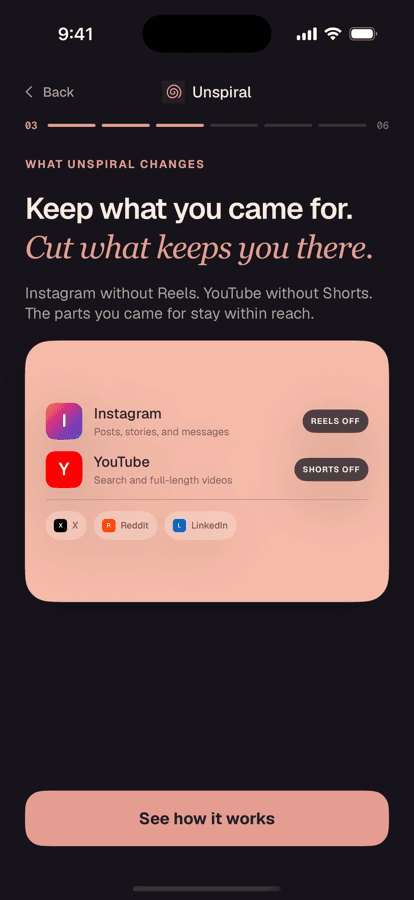
Open your social sites through something that strips out the infinite parts. In Unspiral, Instagram loses Reels and YouTube loses Shorts automatically, and you can close the ranked home feeds on X, Reddit, and LinkedIn.
Block the native apps for your bad window
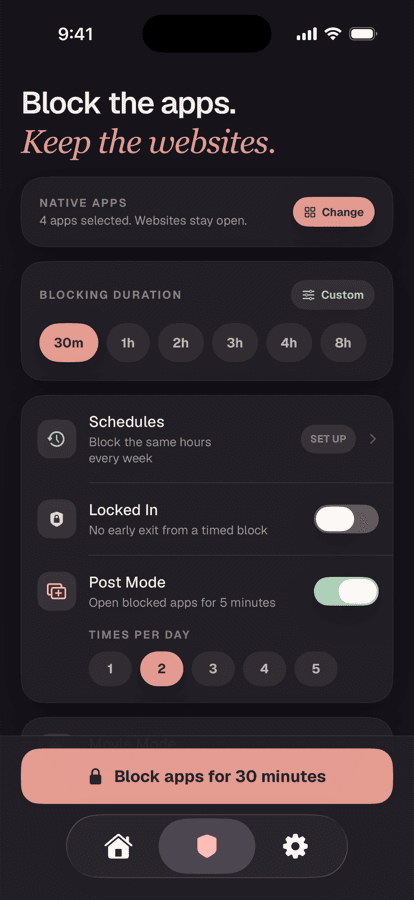
Pick the apps and a duration, then set it to repeat on the days and times you already know are a problem. This uses Apple's Screen Time, so the selections stay on your iPhone.
Use Locked In when you mean it
For the times you know you'll talk yourself out of it, Locked In removes the early exit entirely. There's no cancel button, and the app can't be deleted until the break ends. Read the duration carefully before you start this one.
Give it a fortnight
The first few days after removing an infinite feed feel strange. You'll open the app, find nothing to scroll, and close it again, several times an hour. That reflex is the habit looking for the surface, and it fades faster than you'd expect.
What tends to replace it is the thing you actually wanted from the app in the first place. You message people back. You look something up and leave. It's a smaller relationship with your phone, and for most people that's the entire goal.
Frequently asked questions
What is doomscrolling?
Doomscrolling is continuing to scroll a feed past the point of enjoyment or intent, often through negative or emotionally charged content. It's characterized less by what you're reading than by the fact that you didn't decide to start and can't easily decide to stop.
How do I stop doomscrolling at night?
The most effective approach is a recurring block covering the specific window, usually the hour before bed, rather than relying on a decision made while tired. Removing the infinite surfaces such as Reels and Shorts helps more than a screen time reminder, because there's no endless feed left to fall into.
Does deleting social media apps stop doomscrolling?
It works while it lasts, but most people reinstall within a couple of weeks because the apps carry genuine utility such as messages and events. Removing only the infinite surfaces while keeping messaging and posts tends to survive much longer than full deletion.
Is doomscrolling actually bad for you?
Research consistently links heavy passive social media use with lower mood and worse sleep, though causation runs in both directions and effect sizes vary between studies. The more practical measure is whether the time was chosen. A 2026 Virgin Media O2 study found 36% of phone use happened with no clear purpose.
How long does it take to break the habit?
Most people report the reflex of reaching for a feed fading within one to two weeks once the feed is no longer there to reward it. The habit loop needs the surface to persist, so removing the surface degrades it faster than resisting it does.